
From the stiff, towering ruffs of Tudor courtiers to the artfully knotted cravats of Regency dandies, the history of the starched collar is really a history of power, vanity, and the extraordinary lengths humans will go to look important — even when it means starching their dinner off the table.
Few garments in the history of fashion have commanded as much attention — or required as much effort — as the starched collar. From the towering ruffs of Elizabethan courtiers to the crisp wing collars of Victorian gentlemen, the art of starching cloth into architectural shapes defined European dress for centuries. What began as a practical solution to a laundry problem became one of the most potent symbols of wealth, status, and social refinement the Western world has ever worn around its neck.
The Origins of Starch
Starch as a fabric stiffener has ancient roots — the Egyptians used plant-based pastes on linen — but its application to fashionable dress took hold in 16th-century Europe. The technique involved boiling wheat, rice, or potato starch into a liquid, soaking the linen in the mixture, and then pressing the stiffened cloth into shape with heated irons. The result was fabric that held crisp folds, dramatic pleats, and elaborate forms that would otherwise collapse within minutes.
The craft was demanding enough that a new professional emerged to meet it: the starcher, or laundress specialising in fine linen. In the 1560s, a Flemish woman named Dinghen van den Plasse is often credited with introducing the art of professional starching to England, reportedly charging handsomely to teach London's elite laundresses her methods. Queen Elizabeth I herself was said to be among her most distinguished clients.
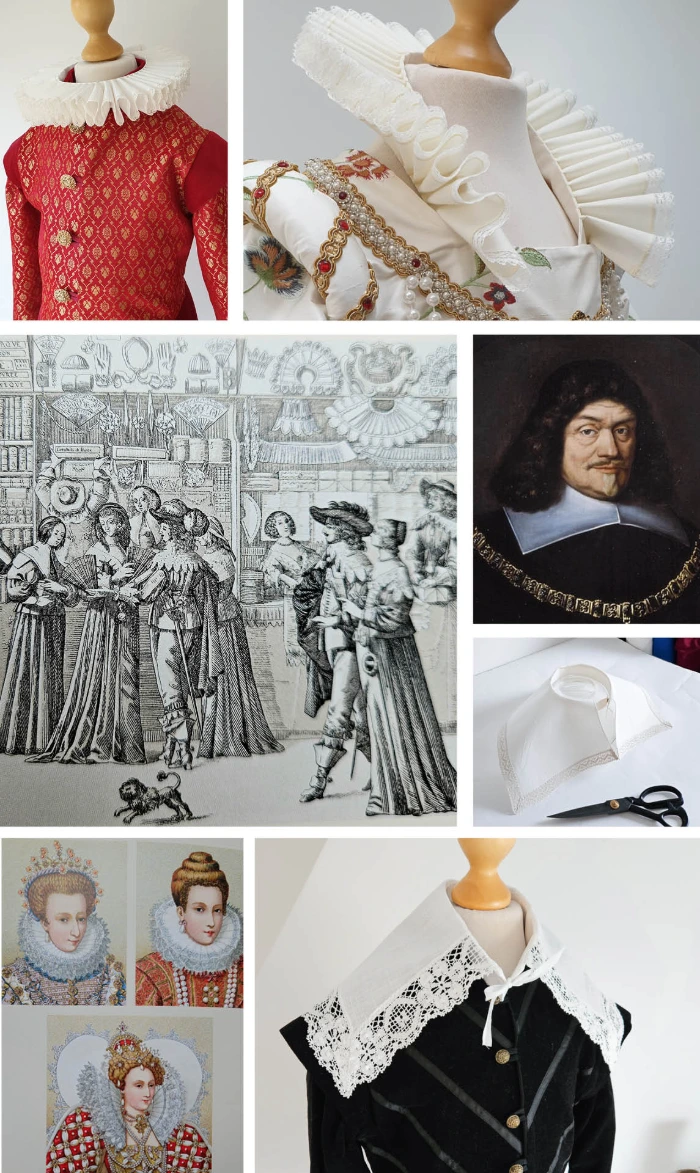
Picture credit: Pictures of the collars seen above are my own. Illustrations used are from August Racinet, The Complete Costume History as well as Maximilian Graf von und zu Trauttmansdorff (Porträt from the Friedenssaal of the Historical Town Hall Münster, 1648)
The Renaissance Ruff: Europe's Most Theatrical Collar
The ruff — a gathered or pleated frill worn around the neck — emerged in the mid-16th century and became the defining collar of the Renaissance. Growing from a simple gathered neckline trim in the 1540s and 50s, it ballooned into an elaborate, free-standing sculpture of pleated linen by the 1580s and 90s.
The Figure-Eight Ruff was the most iconic form: starch-stiffened linen pleated into a series of interlocking loops that fanned out horizontally from the neck in a continuous ring. Large examples required yards of fabric and a specialised curved iron called a poking stick to set each pleat; some fashionable specimens measured a foot or more in diameter, effectively framing the wearer's head like a saint in a painting.
The Cartwheel Ruff represented the extreme end of the form, growing to enormous widths at the height of Elizabethan fashion. So large were some examples that diners famously required elongated spoons to eat without disturbing their collars — a tidbit repeated so often it may be apocryphal, but speaks to just how impractical this particular status symbol became.
The Open or Fan Ruff softened the symmetry of the classic cartwheel by wiring the ruff open at the front to frame the face, particularly fashionable for women in the late 16th century. This style allowed a lower neckline to be visible at the front while still presenting a dramatic frame of pleated linen at the sides and back.
The Falling Ruff, popular in the early 17th century as taste shifted toward softer silhouettes, preserved the pleated form of its predecessors but allowed the linen to drape downward over the shoulders rather than standing erect. It marked a transitional moment between the rigid geometry of full Renaissance dress and the more relaxed aesthetic of the early Baroque period.
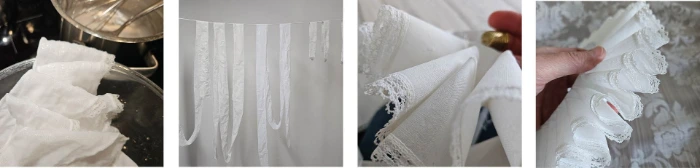
Starching in four easy steps
1
The recipe
1-2 tablespoons of starch to 1 cup of water.
You'll have to experiment with proportions and your locally available starch.
I use potato starch, but wheat or barley would be historically more accurate. Cornstarch can work, too.
2
Cook the starch
Sift the starch into the cold water.
Bring to the boil under constant whisking.
Switch off the heat as soon as the starch becomes gooey.
3
Apply the starch
Let the starch cool a little, then work into the wet fabric.
Remove any excess to avoid blotches and lumps on your fabric.
4
Iron
Once the starched piece of fabric is dry, spray lightly with water then iron between two sheets of baking paper.
If you are re-starching a collar, you need a hot "poking stick" or curling iron to do this and it's worth pinning the collar into shape before ironing.
The Fall of the Ruff and the Rise of the Falling Band
By the 1620s and 1630s, the ruff had largely given way to the falling band — a broad, flat collar that lay open over the shoulders. Helped along by the softer fashions imported from France and the Netherlands, the falling band required far less starch than a standing ruff and was often trimmed with lace rather than shaped into geometric pleats.
The Van Dyck Collar, named for the Flemish painter Anthony van Dyck who depicted it in countless aristocratic portraits, is the most recognisable version of this type. Wide, lace-edged, and dramatically draped over the shoulders, it became synonymous with the courtly elegance of the 1630s and 40s across England, France, and the Dutch Republic. It is perhaps the first collar in history to be named after an artist rather than a technique or a region.
The Puritan Collar, arriving in the New World with the first English settlers of the 1620s and 30s, was in many ways a deliberate rebuke to everything the Van Dyck represented. Plain white linen, flat, modest in width, and entirely free of lace or ornament, it reflected the Puritan conviction that elaborate dress was a form of sinful vanity — the pilgrim collar as theological statement. Paradoxically, it still required careful laundering and pressing to maintain its crisp, bright white appearance, meaning that even in rejecting the excesses of Old World fashion, the settlers carried the art of the starcher with them across the Atlantic.
The lace-trimmed falling band remained fashionable until the Restoration period of the 1660s, when the cravat began to displace it — brought to England by Charles II returning from exile in France, where Croatian mercenaries had introduced the knotted neckcloth during the Thirty Years' War and given it its name. The cravat would remain the dominant form of men's neckwear for the next century and a half, reaching its most theatrical extreme during the Regency period of the early 19th century, when dandies like Beau Brummell elevated the tying of a cravat into an art form. The era of the dramatic pleated collar was over, but the era of the dramatic knotted one was just beginning.
Starch as Social Currency
Throughout the Renaissance and early modern period, the condition of one's collar was a direct advertisement of one's means. Starch was expensive, the professional skill to apply it was costly, and linen fine enough to hold intricate pleats without tearing was a luxury in itself. A brilliantly white, perfectly set ruff announced that its wearer employed skilled laundresses, could afford to replace linen frequently, and did not engage in any form of manual labour — a collar, after all, shows every speck of dirt and wilts within hours of hard work.
Moralists and satirists of the period understood this perfectly. Sermons and pamphlets frequently attacked the ruff as a symbol of vanity and extravagance. Philip Stubbes, in his 1583 Anatomie of Abuses, reserved particular ire for the great ruffs of his day, describing them as "great and monsterous" and lamenting the quantities of starch consumed in their making. The very excess he condemned was, of course, precisely the point. The competition between fashion and food eventually became literal: when grain shortages pushed Parliament to act in 1756, starch was explicitly included alongside corn, flour, and bread in a prohibition on exports — a striking reminder of just how much edible grain the nation was feeding to its collars.